From the Prologue of Ochrid
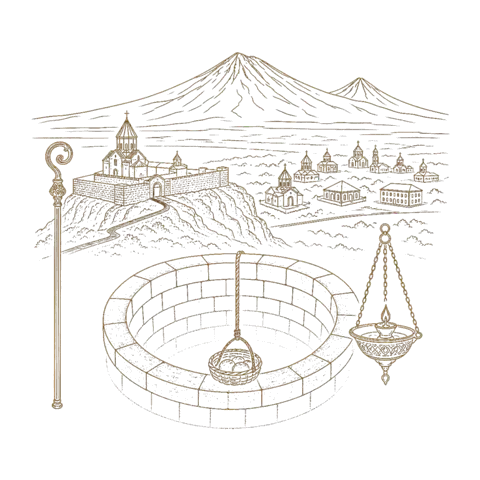
Born into a notable family that was related to the royal house of Persia (King Artaban) and of Armenia (King Kursar). When these two houses warred against each other, Gregory withdrew to Caesarea in Cappadocia, where he first came to know the faith of Christ, was baptized, and married. From that marriage he had two sons, Orthanes and Arostanes, and both he dedicated to the service of the Church. After the death of his wife, Gregory returned to Armenia and placed himself in the service of King Tiridates. And Gregory served his king faithfully, and the king loved Gregory. But when the king learned that Gregory was a Christian, he grew exceedingly angry and began to persuade him to renounce the faith of Christ and bow down to the idols. Not succeeding in this, Tiridates subjected Gregory to grievous torments, and after many tortures cast him into a deep pit filled with every kind of venomous creature, so as to kill him utterly. But God the All-Seeing preserved Saint Gregory alive in that pit for a full fourteen years. Tiridates then continued his persecution of Christians throughout his kingdom, and attacked a convent where there were thirty-seven sisters with their abbess Gaiana. When he had slain them all with dreadful tortures, Tiridates went mad and became like a wild boar. But to the king's sister there appeared in a dream a man of surpassing radiance who told her that her maddened brother would not recover until Gregory was taken out of the pit. When he was taken from the pit, Saint Gregory healed and baptized Tiridates. After that, Gregory, at the desire of Tiridates, became Bishop of Armenia, and with the help of the king, and first of all of God, he enlightened all of Armenia and the surrounding regions with the faith of Christ. And Saint Gregory ended his life of many labors in old age, around the year 335. In his place his son Arostanes was consecrated bishop, and he continued the work of his father, both physical and spiritual. Arostanes was one of the 318 Holy Fathers at the First Ecumenical Council.