From the Prologue of Ochrid
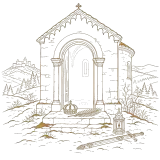
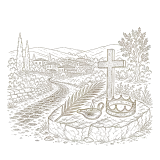
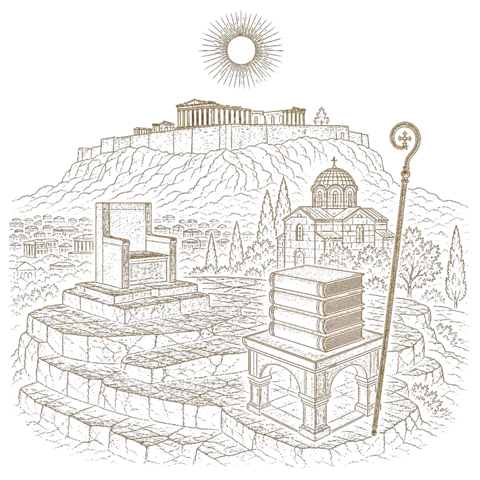
He is numbered among the Seventy lesser Apostles. This wondrous man was of a distinguished pagan family from Athens. Having completed his studies in philosophy at Athens, he went to Egypt to continue his education. At that time, one day the Lord Christ breathed His last upon the Cross, and the sun was darkened, and there was darkness in Egypt as well for three hours. Then Dionysius exclaimed: "Either the God who created the world is suffering, or this world is coming to an end." Returning to Athens, he married a woman named Damaris and had sons with her. He was a member of the supreme court of the Greeks, the Areopagus, whence he retained the name Areopagite. When the Apostle Paul preached the Gospel in Athens, Dionysius was baptized with his entire household. He was consecrated by Paul as bishop of Athens (for he had left wife, children, and position for the love of Christ). He traveled with Paul for a considerable time and became acquainted with all the other apostles of Christ. He traveled especially to Jerusalem to see the Most Holy Theotokos, and described that meeting with her in one of his works. He was also present at the funeral of the Most Holy and Most Pure One together with the other apostles. When his teacher Saint Paul suffered a martyr's death, Dionysius also desired such a death for himself. And he went to Gaul to preach the Gospel among the barbarians, together with Rusticus the presbyter and Eleutherius the deacon. They suffered much but also accomplished much. By his labors many pagans were converted to the faith of Christ. Dionysius built a small church in Paris where he served the divine services. When he was ninety years old, he was seized and tortured for Christ, together with Rusticus and Eleutherius, until all three were finally beheaded by the sword. The severed head of Saint Dionysius bounded a great distance and fell before a certain Christian woman named Catula, who honorably buried it together with his body. He suffered in the time of Domitian in the year 96. He wrote notable works: On the Divine Names, On the Celestial and Ecclesiastical Hierarchy, On Mystical Theology, and On the Most Holy Theotokos.