The life of St Porphyrius of Gaza
Together with Bishop John of Caesarea and his own deacon, Mark, he traveled to Constantinople in the winter of 401 to 402, seeking the emperor's help against the paganism still entrenched there, and was counseled to approach the matter through the empress Eudoxia, promising her that the child she then carried would be a son. A son was indeed born, and an imperial edict followed ordering the destruction of Gaza's pagan temples and the restoration of the city's Christians to their rightful standing. The imperial envoy Cynegius carried out the decree in May 402, destroying the Marneion and several other temples.
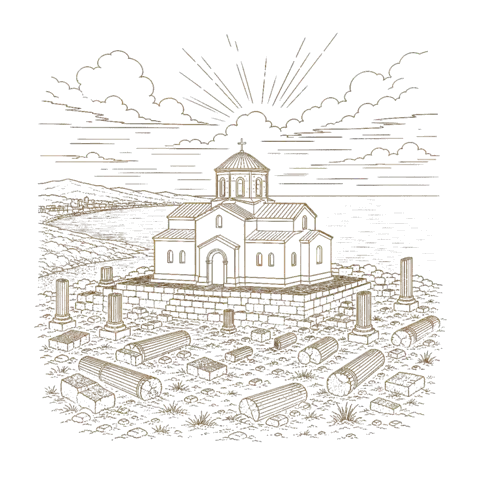
Porphyrius himself directed the demolition of the Marneion, the great temple raised to the local god Marnas, and in its place, funded by Eudoxia and built by an architect she sent from Antioch, a grand new church of thirty-two marble columns rose, dedicated in 407.
He reposed in 420, at about seventy-two. The fullest ancient account of his life comes from his own deacon Mark, whose closeness to Porphyrius makes it valuable even though the surviving text is a later recension, drawing on a lost Syriac original that itself appears to be a sixth century reworking; historians have long noted internal inconsistencies that limit how far it can be trusted in every particular. The central fact it records, the fall of Gaza's great temple and its replacement by a church, stands independently confirmed all the same.