The life of St Martinian of Caesarea
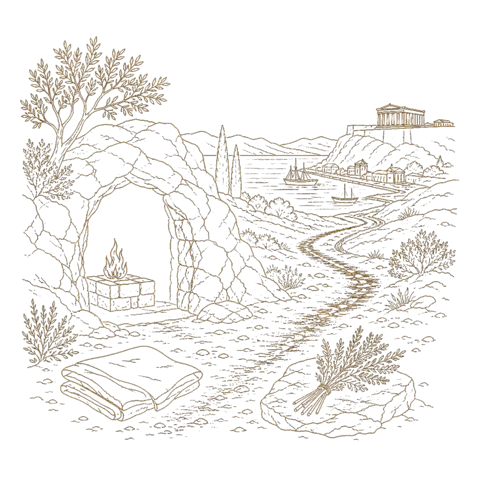
A woman of the city, hearing others speak of his virtue, wagered that her beauty could undo it, and came to his cell to test him. Rather than yield, Martinian lit a fire and stepped into it, telling her in effect that he would rather burn in the flame before him than in the fire that waited for those who gave way to such temptation. Struck by what she had witnessed, the woman, remembered as Zoe, repented on the spot and asked his guidance; he sent her to Bethlehem, to the convent Paula had founded there, where she lived out the rest of her life, some twelve years, in a strictness matching his own. Martinian himself, his burns healed, withdrew afterward to a bare rocky island in the sea, living there under the open sky for years on provisions a sailor brought him from time to time, weaving baskets in return. There a second woman, Photina, reached the island alone after her ship went down nearby. Tradition holds that Martinian, unwilling to remain there with her, committed himself to the sea rather than risk a second such trial, and swam for the mainland, leaving Photina safely on the island until sailors later found her. He went on to Athens, where he fell ill and died, still unrecognized until the local bishop learned who the dying stranger was and gave him burial with full honors, around the year 422. He is remembered together with Zoe and Photina on this day. A distinct Photina, the Samaritan woman of the Gospel account, is a different person from an earlier century and is not this Photina of Caesarea.