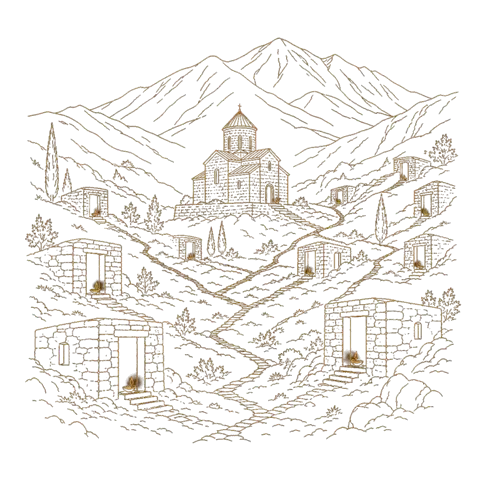
The Holy Fathers of Georgia

Our Holy Fathers of Georgia (6th c.)

Orthros artwork for the life of The Holy Fathers of Georgia
Orthros artwork

From the Prologue of Ochrid

In the sixth century, two hundred years after Saint Nina had preached the Gospel in Georgia, the Most Holy Theotokos appeared to John, an ascetic of Antioch, and commanded him to choose twelve of his disciples and go to Georgia to strengthen the Orthodox faith. John did so. Upon arriving in Georgia, these twelve missionaries were solemnly received by the prince of the land and Catholicos Eulalius, and immediately began their work with zeal. The people gathered around them in crowds, and they strengthened them in the faith with great wisdom and many miracles. The leader of all these Christ-loving missionaries was Saint John of Zedazeni. And their names were: Abibus, Anthony, David, Zenon, Thaddeus, Ishe, Isidore, Joseph, Michael, Pyrrhus, Stephen, and Shio. With apostolic zeal they all strengthened the faith of Christ in Georgia, founded many monasteries, and left behind many disciples. Thus they were deemed worthy of glory in heaven and of power on earth.

“The Christian faith lies not in the worldly wisdom of human sensory reason but in the power of God.”
Also commemorated on May 7

Learn about similar saints

Questions

When is the feast day of the Holy Fathers of Georgia?
The Orthodox Church commemorates the Holy Fathers of Georgia on May 7 on the New Calendar and May 20 on the Old Calendar.
Who else is commemorated on that day?
The Church also remembers St Acacius the Centurion at Byzantium, St Alexis Toth and St Lydia of Philippi.
When is the feast of the Holy Fathers of Georgia in 2027?
In 2027, on the New Calendar, it falls on Friday, May 7.

In Orthros

On the feast day Orthros sets the life of the Holy Fathers of Georgia before you, beside the day's fast and readings, free to read.

No trackers. No ads. No data sold. Ever.

help@orthros.app

Available for iPhone, iPad, Mac, Apple Watch and CarPlay

Orthros · an Orthodox prayer companion, made by Orthodox Christians, for everyone. Not an official work of any Church body.

Scene & ornament artwork © Orthros, its own drawn work, not historical icons. Source and license details identify received texts and editions. Orthros editorial teaching is labeled separately.