From the Prologue of Ochrid
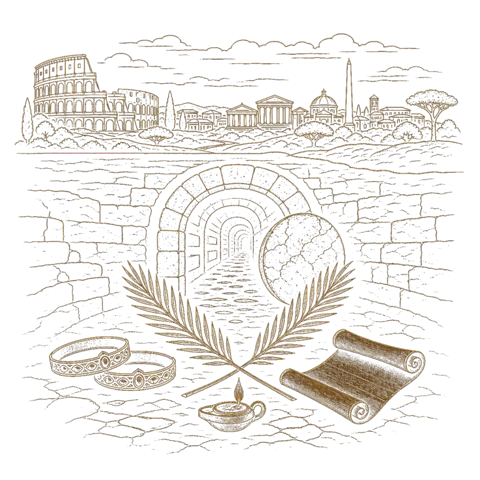
Chrysanthus was the only son of a great nobleman named Polemius, who had moved from Alexandria to Rome. As the son of wealthy parents, Chrysanthus studied all the worldly schools, having the most learned men as his teachers. But worldly wisdom confused him and left him uncertain as to what was truth. And he grieved over this. But God, Who provides for all and for everything, relieved his grief: into the hands of the young Chrysanthus came a written Gospel and the Acts of the Apostles. Having read these, Chrysanthus was illumined by the truth. Yet he desired a teacher, and found one in the person of a certain Carpophorus, a priest, who both instructed him and baptized him. But this did not please his father, who tried everything to turn him away from the faith of Christ. Having accomplished nothing, the wicked father first sought to corrupt him by shutting him alone with shameless girls. But Chrysanthus overcame himself in this also, and preserved his purity. Then his father compelled him to marry a pagan girl named Daria. But Chrysanthus counseled Daria to receive the faith of Christ as well, and to live as brother and sister, though outwardly in marriage. When his father died, Chrysanthus began freely to confess Christ and to live as a Christian — both he and all his household. In the time of Emperor Numerianus, both he and Daria were terribly tortured on account of their faith. But even their very torturer Claudius, seeing the patience of these honorable martyrs and the miracles that manifested themselves during their torment, received the faith of Christ together with his whole household. For this, Claudius was drowned in water, both his sons were beheaded, and his wife at the place of execution, having read a prayer, breathed her last. Daria was so steadfast in her torments that the pagans cried out: Daria is a goddess! At last the order was given that Chrysanthus and Daria be buried alive under stones in a deep pit. A church was later built on that site. Near that pit there was a certain cave, into which some Christians once gathered for prayer and communion in memory of the holy martyrs Chrysanthus and Daria. When the pagans learned of this, they rushed to seal up that cave, and thus by death drove those Christians from this world into a better world, where Christ the Lord reigns in eternity. These glorious martyrs, Chrysanthus and Daria, and the others with them — among whom were Diodorus the priest and Marian the deacon — suffered for Christ in Rome in the years 283 and 284.