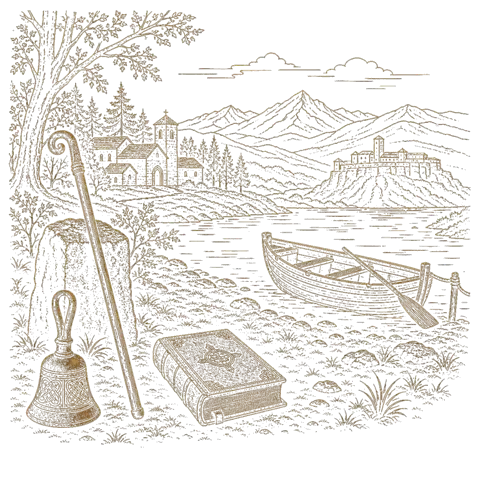
The life of St Columban of Luxeuil
King Guntram granted them land at Anegray, and the community soon moved to Luxeuil, a ruined Gallo-Roman fortress around which Columbanus raised the monastery that took its name, governing it under a rule drawn from Bangor's own Celtic customs; Luxeuil grew quickly into the most important religious house in Gaul, and a second community rose nearby at Fontaines.
His insistence on the Celtic reckoning of Easter and the Irish tonsure set him against the Frankish bishops, a dispute he carried as far as an appeal to Pope Gregory the Great, left unresolved at Gregory's death in 604. He also rebuked the young king Theuderic II for keeping a concubine, drawing the anger of the king's grandmother Brunhilda, who had him imprisoned and then driven into exile in 610 with only his Irish brethren allowed to follow him. After a failed attempt to sail for Ireland, he found refuge under King Theudebert II at Bregenz on Lake Constance, where his companion Gall remained after Columbanus moved on, in time founding the abbey that still bears Gall's name. War between Frankish kingdoms drove Columbanus across the Alps into Lombardy, where King Agilulf and Queen Theodelinda welcomed him and granted him the land at Bobbio where he raised his last monastery, between about 612 and 614.
Unlike most early medieval saints, whose lives survive chiefly through a later hagiographer's telling, Columbanus left behind his own letters and monastic rule, a rare direct voice reaching across the centuries.
He died at Bobbio on November 21, 615, remembered as one of the great architects of Irish monasticism's reach into continental Europe, a legacy built on foundations he raised himself rather than one told only by others afterward.